One source, four interpretations.
―― Yoshinkan Honke stands within the "real-combat mainstream".
Not a sequence. The four moved simultaneously, in different directions.
Yoshinkan Honke stands on the ground of "real combat."
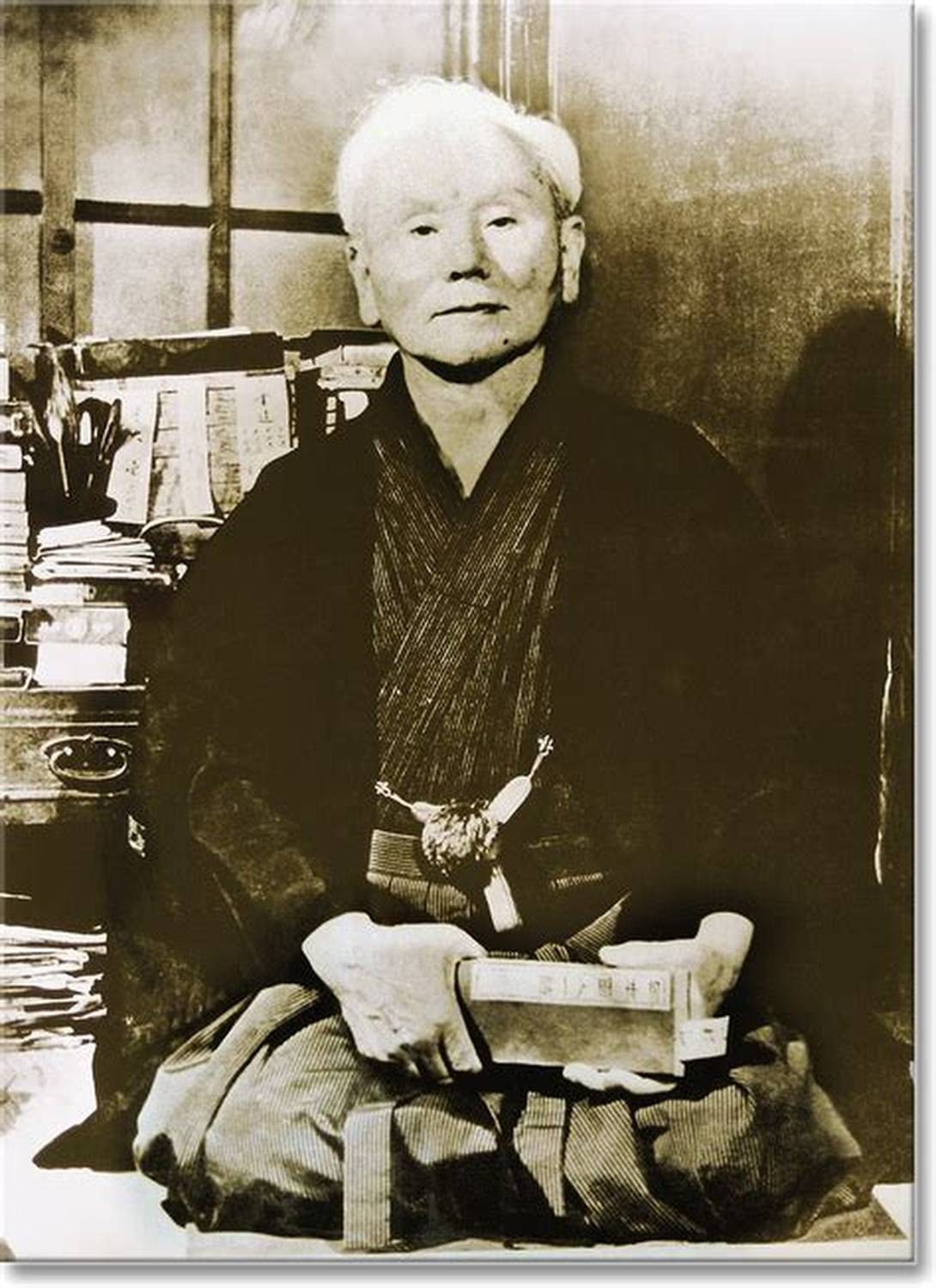
―― Karate that does not fight. Funakoshi's teaching, untouched.
The conviction that Gichin Funakoshi held throughout his life was the prohibition of kumite.
Rejecting striking exchanges, he transmitted the essence of karate solely through kata ―― that is, "form."
In our age, the one that most faithfully preserves that teaching is Nihon Karate-dō Shōtōkai.
It includes original-form kata not practised by other Shōtōkan schools. To study the origin of Shōtōkan karate, one must learn here.
―― Pioneers of kumite, and the systematisation of real-combat karate.
The pioneer of kumite in Shōtōkan karate was Shōtōkan Okano-ha (1942 · Kenkōjuku), founded by Sōke Tomosaburō Okano. The first to break away from Funakoshi's teaching, he opened the path to a "karate that strikes."
Jigenkai (Sagami Gym · 1972), which inherited that current, is the mainstream.
At this place founded by the late Katsumi Nagatomo, members actively entered matches in kickboxing, Muay Thai, Kyokushin karate, and Shidōkan ―― and through this, systematised Shōtōkan karate as "real-combat karate."
And the very birth of Japanese kickboxing ―― Noguchi Boxing Gym introduced kicks into boxing, establishing a unique Japanese striking art. Kyokushin, this Shōtōkan real-combat lineage, Nihon Kenpō ―― these gathered, aiming for the summit of striking. It was natural that many kickboxers had karate origins.
※ As time passed, "kickboxing/Muay Thai" became independent sports, and the fact that their source lay in karate is now being forgotten.
―― Traditional karate that strikes, and karate as competition.
They take impact deep. The strike connects, and stops there ―― embodying the "real combat" of traditional karate most strongly.
Judging is strict, with a strong tendency to reward the imagery of full impact.
A federation where various schools gather. The aspect of sport is strengthened.
Judging is lenient, run on a points system. Even when Shōtōkan unions or federations differ, they enter the same competitions ―― the boundary seems present, yet absent.
Between the two, there are slight differences in the form of karate, and opinions can split on that judgment.
―― The peak of sportisation, and the centre of the world.
With the World Karate Federation (WKF · HQ Spain) at its centre, JKF, JKA, and other federations and associations have all been influenced.
With the Olympics in its sights, karate has transformed rapidly into sport.
Karate uniforms, match belts, rules, judgments ―― everything has shifted to sport specifications.
Do the teachers and practitioners of Japanese karate-dō, those who have studied it for generations, not find this concerning?
In such a moment, returning to the origin ――
a stream like Nihon Karate-dō Shōtōkai deserves greater attention.
―― We honour the origin that does not fight (Shōtōkai),
―― We respect the traditional two giants (JKA · JKF),
―― We do not deny the sportisation of the world (WKF).
But what Yoshinkan Honke inherits is ――
the single "real combat" lineage that flowed from Shōtōkan Okano-ha to Jigenkai.
You know where we stand. Now let us look at the actual technical system of Yoshinkan-ryū.
Jūjutsu · Karate · Kenpō — three integrated, the substance of the modern Otome-ryū.