

Otome-ryū ・ A Little More Deeply.
What an introduction cannot fully convey, we have gathered into a series of short readings. What is Otome-ryū? Why is kata not enough? How does it differ from public practice? What is bushidō? Why is it rooted in this land? Read in sequence, the outline becomes clear.
To Whom Should Strength Be Passed?
What is Otome-ryū (御留流)? Why was it never made public? Not secrecy, but the very idea of responsible inheritance. A universal truth that reaches from the samurai era to those who hold power today, in five minutes.
Read on →Not Just Kata Karate.
Kata is the vessel; real-combat breathes life into it. The history of the ring at Yoshinkan's roots, and the self-control of never having to fight — that balance, in five minutes.
Read on →Public Practice ・ and Otome-ryū.
There are two paths in martial training, different in character. Open public practice for anyone, and Otome-ryū, passed only with responsibility to those who are fitting. What truly separates them — read in contrast.
Read on →The Dignity of Those Who Bear a Sword.
What was bushidō, truly? Why did the great houses keep martial arts within? What was inherited was not technique alone. The dignity of those who bear a sword — read from history, for those who carry responsibility.
Read on →Mountains and Highways Raised the Warriors.
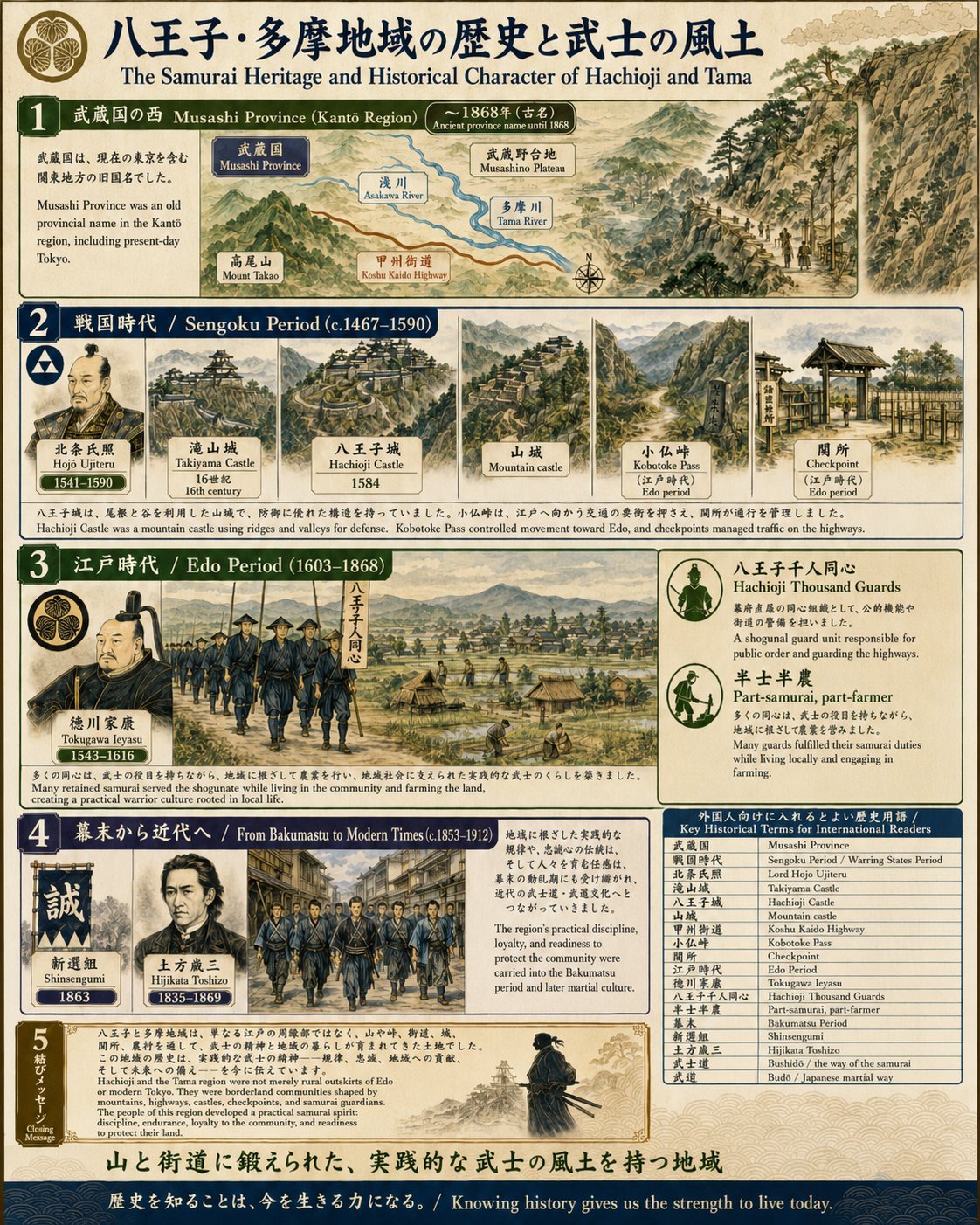
Hachioji and Tama were not merely Edo's outskirts. Castles, checkpoints, highways, warrior bands — a samurai spirit rooted in the land. Trace the necessity of Yoshinkan Honke's place here, through history and visual chronology.
Read more →From a kindergarten rooftop, a lineage of real combat.
Jigenkai began in a prefab hut on a kindergarten rooftop. Under Katsumi Nagatomo, the path to prove Shotokan Okano-ha in real combat began. The story of Makoto Nozaki — who learned from the founding days, inherited both form and combat, and became the one and only head instructor.
Read more →