


Yoshinkan Honke is rooted in the Tama area of Tokyo. Tama — now known as a residential and university district of western Tokyo — was, when traced back through history, not merely a suburb of the capital. It once belonged to Musashi Province (武蔵国), a land where the culture of eastern warriors took deep root.
Why is Otome-ryū here? The answer lies in the history of the land itself. We trace, across five eras, how this land — forged by mountains and highways — raised a practical samurai character.
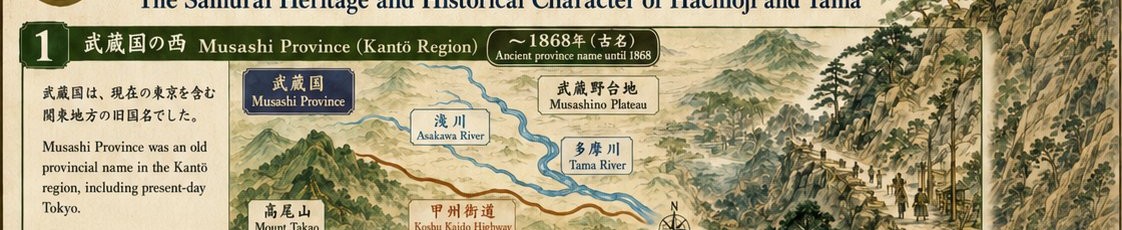
Musashi Province ・ where mountains, rivers, and highways converge.
Until the Edo period, Tama and Hachioji were part of the old Kantō province called Musashi (武蔵国). The Tama River and the Asakawa River flow through it, the Musashino Plateau spreads to the north, and to the west Mount Takao stands. Cutting through this terrain runs the Kōshū Kaidō Highway (甲州街道), the route connecting Edo to Kai Province (today's Yamanashi).
This was a land where mountains, rivers, and highways converged. Militarily, in transport, in logistics — for one who sought to govern the Kantō, to hold this place was to grasp influence over all the eastern lands. It was no accident that warriors gathered here and were forged in this place.
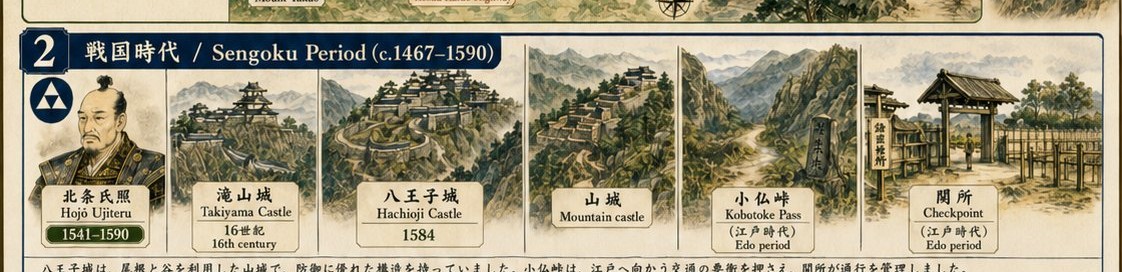
Sengoku Period ・ a castle that made the mountain itself a shield.
In the Sengoku Period, this land was governed by the Later Hōjō clan, based in Odawara. Their lord Hōjō Ujiteru (北条氏照, 1541–1590) first used Takiyama Castle (滝山城) as his base, and later built the more formidable Hachiōji Castle (八王子城, 1584).
Hachiōji Castle was neither a European stone fortress nor a Japanese plains castle commanding the flat. It was a mountain castle (yamashiro) — using ridges and valleys as defensive lines, making the mountain's very terrain a shield. Neither ornament nor symbol of authority, it was a castle designed purely to defend, purely to win.
Entering the Edo period, beyond Takao lay Kobotoke Pass (小仏峠), where a checkpoint (sekisho) was placed. This was a critical point where the shogunate strictly examined people and goods moving toward Edo — a frontier defense for the capital. Such was the geopolitical position of Hachioji and Tama.
In this region were not samurai who only performed ceremony in the center of the capital — but samurai who guarded mountains, guarded highways, guarded the land. There was a bushidō rooted in the soil.
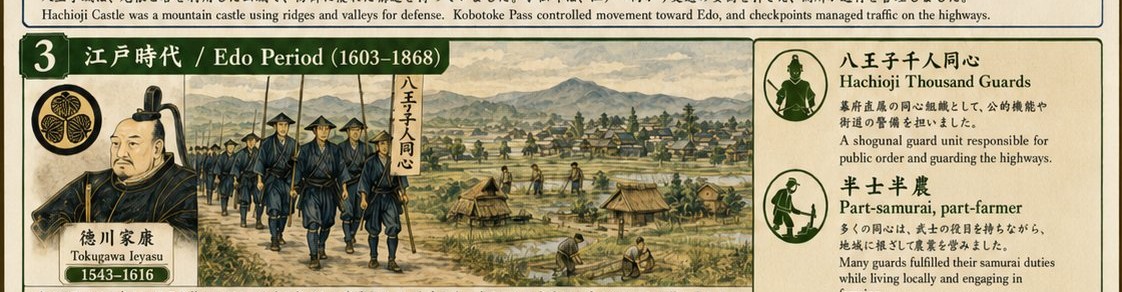
Edo Period ・ Hachiōji Sennin Dōshin, the shogunate's trust.
When the Edo shogunate was founded, Tokugawa Ieyasu placed a singular warrior corps in Hachioji and Tama: the Hachiōji Sennin Dōshin (八王子千人同心) — a thousand-strong armed organization, as its name proclaims.
Their duties were heavy and varied. The guarding of Nikkō Tōshōgū, the patrol of the Kantō highways, and arms in defense during emergency. The shogunate placed direct trust in this land — entrusting a part of Kantō's security to samurai rooted in the soil.
At the same time, they were neither daimyō nor hatamoto. Half-samurai, half-farmer (半士半農) — in times of peace they tilled the fields and lived among the community; in emergency they took up the sword and fulfilled their duties. Not ceremonial samurai, but samurai who drew no line between daily life and martial readiness — that was their figure.
This is a way of "the martial" that we, living in the present day, easily overlook. Martial arts were not upon the stage, nor within the competition ground, but lived in daily life itself. The dōshin of Tama embodied this in life.

Bakumatsu ・ the bloodline of Tama that bore the Shinsengumi.
Entering the Bakumatsu era, from this Tama emerged the core members of the Shinsengumi (新選組, 1863). Kondō Isami, Hijikata Toshizō (土方歳三, 1835–1869), Okita Sōji — all were from Tama, or trained the sword in this land.
The banner of "Makoto" (誠 — sincerity) that the Shinsengumi raised carried within it a vow upon life itself. The sword they displayed in the capital was not a sword of ceremony, but a sword that functioned in the real moment. The "sword that works," raised by the Tama landscape, ran through the upheavals of the Bakumatsu.
While the schools of the capital honored ceremony and beauty, the sword of Tama sought a "useable sword" — the martial art that warriors who protected daily life truly needed, functioning in the actual moment. The region's practical discipline and tradition of loyalty were carried into the turbulent end of the shogunate, and on into the bushidō and budō culture of the modern era.

Why is Otome-ryū here?
Hachioji and the Tama region were not merely Edo's peripheral districts. Through mountains and passes, highways, castles, checkpoints, and farming villages, the samurai spirit and the life of the land were cultivated together. The history of this region carries to the present the practical samurai spirit — discipline, endurance, contribution to community, and readiness for what is to come.
That Yoshinkan Honke is rooted in this place is no accident. Guarded by mountains and highways, with checkpoints forming the frontier, samurai rooted in the soil keeping daily life and martial readiness as one — here lives, even now, a lineage of martial arts that is not ceremony but practice, not form but substance, not made for display but readiness for what may come.
That Otome-ryū is not made widely public has its reasons here too. The practical martial way raised by the land was not made to circulate as a commodity, but as an inheritance suited only to those of responsible position. The character of Hachioji and Tama fits the form of Otome-ryū with precision.
What Yoshinkan Honke seeks to carry into the present is precisely the substance of the warrior raised by this land. Not form, not legend, not ornament — the practical samurai character forged by mountains and highways. We pass it carefully into the hands of those who bear responsibility in the present age. That is the role of Yoshinkan Honke.

Knowing history gives us the strength to live today.
歴史を知ることは、今を生きる力になる。